
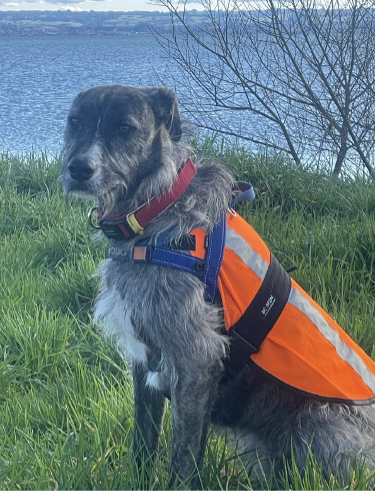
Rotorua Airport’s ‘goodest boy’ is leading the charge in bringing down its rate of bird strikes and near misses – and is getting paid in pats to do it.
Head of Dog Ops, Charlie – a long-haired lurcher owned by Rotorua Airport’s Operations & Infrastructure Manager, Ben Alton – first became an accidental employee after the team discovered his talent for scaring off wildlife around the runway.
Now, with Rotorua Airport’s wildlife incidents tracking downwards, Charlie’s hard work has been recognised with a special award in the 2025 NZ Airports Association Awards.
Sitting on the shores of Lake Rotorua, and neighbouring the Waikawau Wetland Reserve and Lake Rotokawa, Rotorua Airport has traditionally had one of the highest rates of bird strikes and near misses of any airport in the country.
As a result, the Airport is relentlessly focused on the issue, adopting the latest technology, procedures and methods in wildlife management to ensure the ongoing safety of airport users.
Mr Alton says what started out as an agreement to allow his new puppy to come to work, has turned into a blueprint for other airports interested in utilising working dogs to manage birds and other wildlife.
Charlie is currently the only working dog in New Zealand being utilised for wildlife management at an airport.
“I had just gotten Charlie when I started at Rotorua Airport so arranged with my manager to bring him to work. Once he became acclimatised to the airport and the sounds of planes, we started taking him for walks around the property.
“Pretty quickly, we noticed Charlie was chasing off all the birds, rabbits and hares, and we realised that he could be another effective tool to control wildlife on and around the runways.”
Mr Alton says in the two years Charlie has been on the payroll, the number of bird strikes has decreased significantly.
“Dog ops are a particularly effective deterrent for medium to large-sized birds, including plovers, pūkeko, swans and geese, that are all reluctant to return for extended periods following a dog ops patrol.
“In fact, we’ve found dog ops are so effective that the sound of the Polaris Ranger, our dog ops vehicle of choice, is now associated with danger by those bird species and can work as a deterrent even if Charlie isn’t on the job.”
Rotorua Airport expanded its dog operations to multiple handlers in 2024 and has seen its bird strikes go from 25.3 strikes per 1000 movements in Q3 2022, to just 2.9 in Q3 2024.
Mr Alton says the initiative generated significant interest when presented at the 2024 Auckland Aviation Wildlife Safety Conference.
“This year, at the same conference, we were approached by several airports for an informal update and requests to share any advice.
“Dog ops can be a cost-effective yet invaluable addition to an airport’s arsenal of bird deterrents, helping to contribute to a reduction in bird strike incidents at any aerodrome.”
Alongside Charlie, Rotorua Airport uses a range of bird deterrents, including pyrotechnics, reflective spinners, gas canons, sounders, decoys, lasers, and firearms.
“Having Charlie as part of the team is not a gimmick – we’ve seen him have a real impact operationally, plus everyone loves him.
“He’s definitely going to be the start of an ongoing dog ops tradition here at Rotorua Airport.”